

Background
In 2026, GEO has become a topic that brands in China can no longer avoid. It is not necessarily the largest budget item, nor is it always a priority that CMOs actively choose to bet on. In many cases, brands are entering GEO because of the pressure that it is “something we have to do,” rather than the confidence that it will guarantee success.
What GEO has truly surfaced, however, is a much older challenge: whenever a new channel emerges, brands often discover that they do not have a management system robust enough to govern it. Service providers assess their own performance, budgets are difficult to break down, and accountability becomes unclear when problems arise. This is not a GEO-specific issue. GEO has simply brought the issue back to the table.
History Repeats: The Governance Gaps Behind Every New Channel
From eCommerce to Xiaohongshu, from Weibo to content marketing, and now to GEO, channels continue to evolve. Yet the structural gaps brands face in governance remain strikingly consistent:
? Lack of closed-loop auditing, making it difficult to understand where money is spent and whether ROI can be verified
? Lack of pricing benchmarks, resulting in lost negotiation leverage and potential agency conflicts of interest
? Lack of compliance and accountability mechanisms, leading to internal inefficiencies and unclear ownership when issues arise
Every time a new channel gains momentum, the same pattern of disorder tends to reappear. What brands truly lack is not simply a better understanding of the channel itself, but a governance foundation that can respond to change across any channel. GEO may be today’s issue, but the challenge behind it is far more long term.
— Sabrina Li, Managing Director, R3
Solution
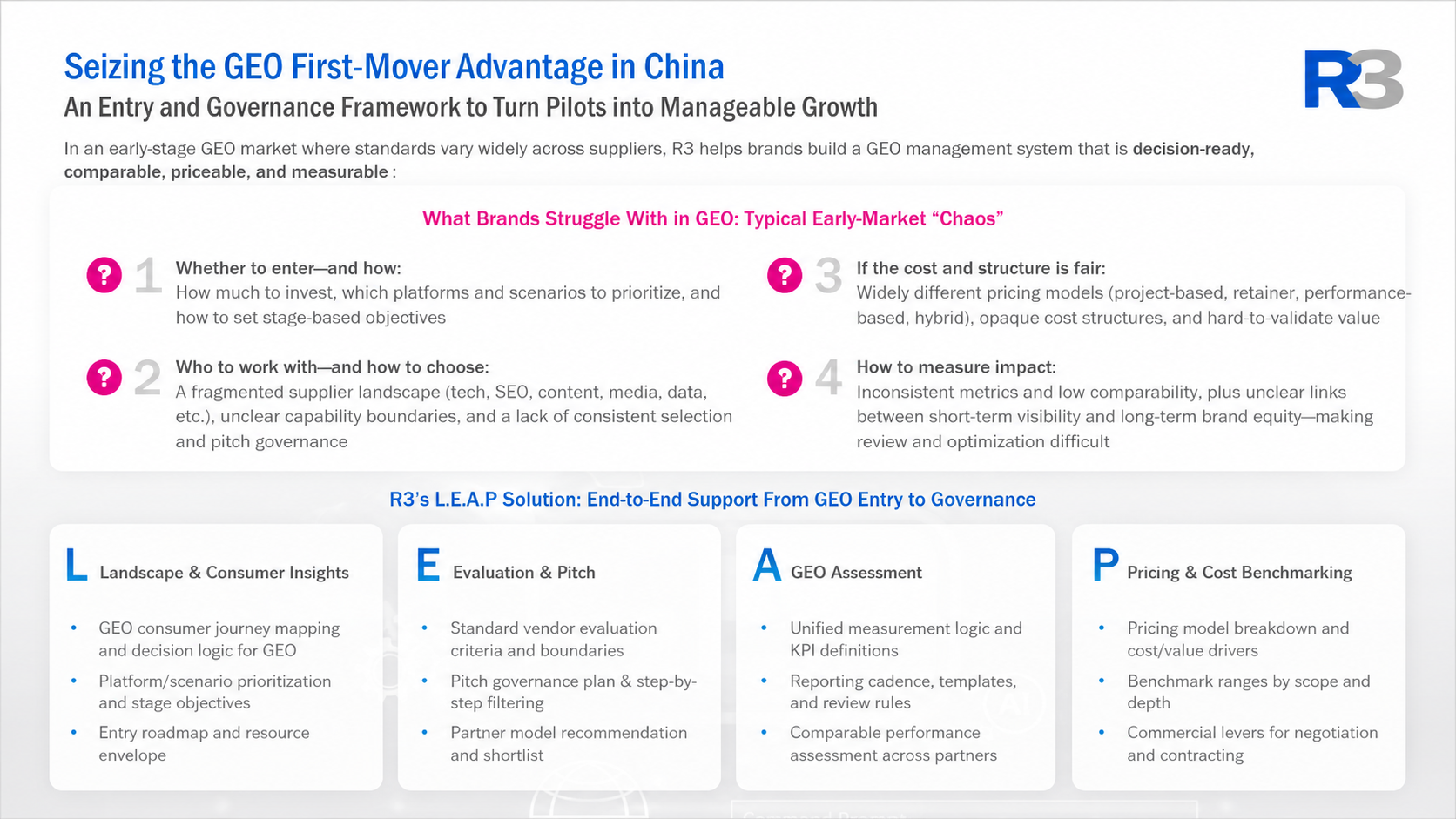
Amid the current wave of AI, GEO is no longer just a technological shift. It represents a broader reconstruction of marketing governance. To address increasingly complex and specific business challenges, companies do not need ‘one more tactic.’ They need a governance system that can turn every marketing dollar from an ambiguous cost into a clear business investment, enabling solutions that are measurable, actionable and fit for purpose.
In an era where marketing management is becoming a battle for greater granularity, there is less and less room for decisions based on instinct alone. If you would like to explore the ideas discussed, or learn how R3 helps leading brands build measurable and actionable solutions, we would be happy to continue the conversation.